
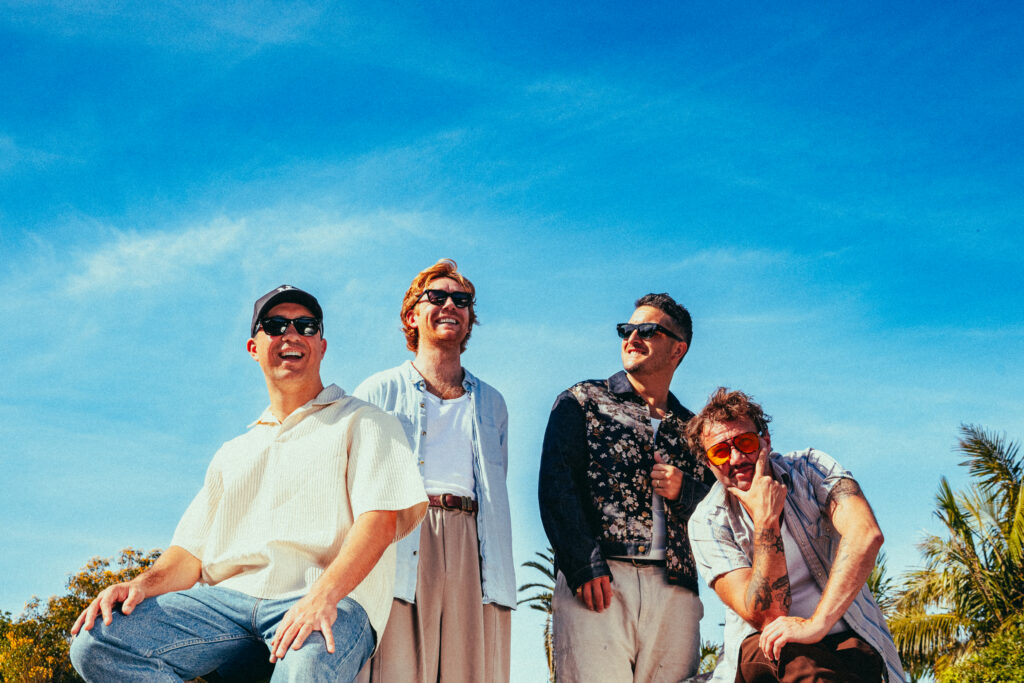
If there’s ever been a band that’s become part of the national landscape, it’s Six60. They’re everywhere – and right now, that includes the airwaves. Once again. Their single We Made It is currently on high rotation, and their name is stamped across the posters of numerous upcoming gigs. Not that they’ve been away. In 2024, they completed a massive Grassroots Tour of small venues, followed by another 12 shows last year, plus a run of dates across the ditch. Somehow, in the midst of all that, they also managed to knock out their fifth album – a project the band describes as a return to their roots.
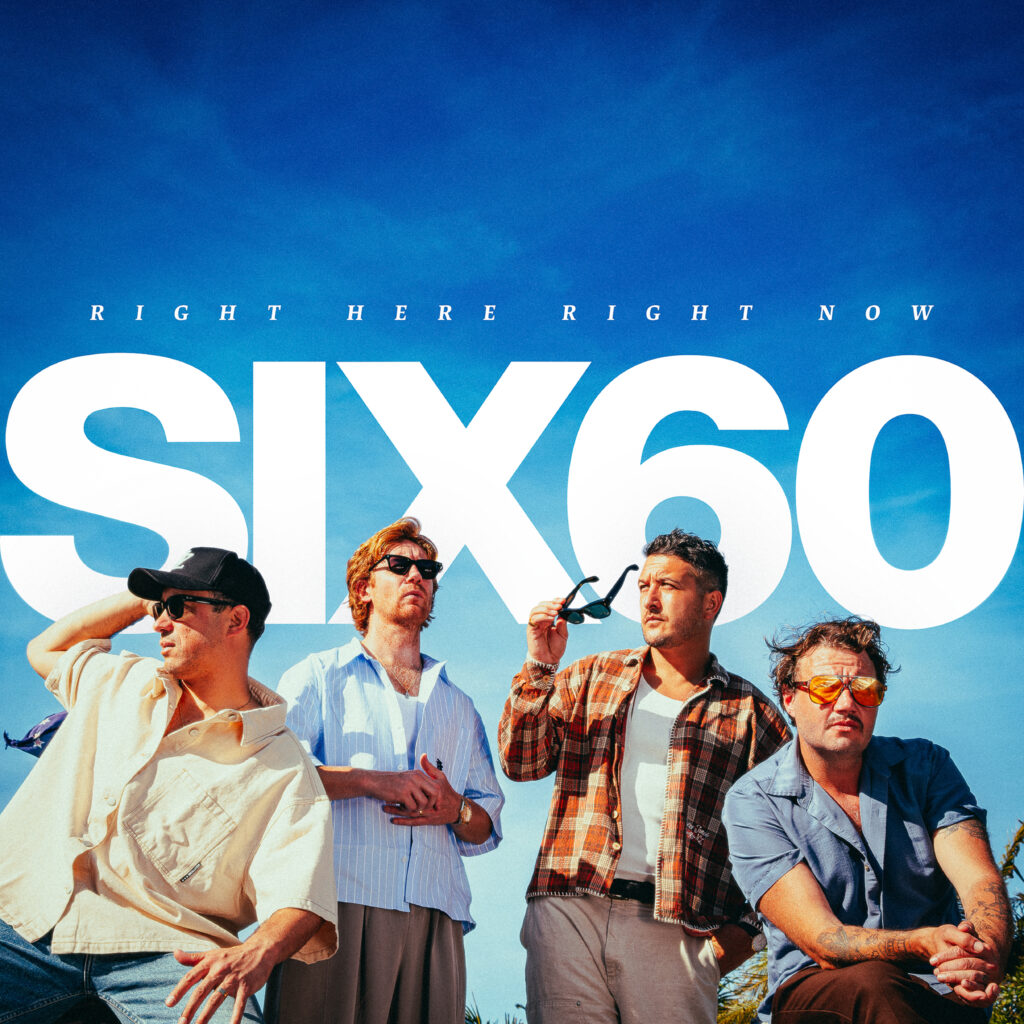
The album’s called Right Here Right Now, and it’s dropping on 13 February 2026. It’s basically Six60 plugging in and capturing the vibes of a real live jam – the whole band, single takes, no fuss. As Matiu Walters puts it in their press, it’s all about “four chords and the truth.” They’ve already whetted everyone’s appetite with the summer singles We Made It, Knocking At Your Door, and We Are All Kings. The release date is set, the live shows are booked, and the band’s socials are buzzing with hype for the launch‑day gig and the first big festivals of the year.
To find out more, Muzic.NZ’s Tim jumped on a call with guitarist Ji Fraser for a bit of a chat about touring, fans, and getting back to what really matters. When in, he’s a tiny bit late. “Sorry,” he says, “There’s about 1000 kids at my house at the moment.” Behind him is a modern room, with big French doors indicating a patio or garden beyond, and, yes, there’s a number of younger kids running around like crazy things. It’s all very suburban. After acknowledging that this is how most Kiwi musicians are after a few years – music, whanau, fame, etc., we kick into a kōrero about the new album and getting back to where it all started – again.
Last year Six60 booked Auckland’s Stebbing Recording Centre and ended up making their new album in record time. “I don’t know if you’ve been to Stebbing’s, it’s amazing!” Fraser is referring to the long‑running Auckland spot where heaps of Kiwi artists have laid down tracks over the years – everyone from Ray Columbus & The Invaders to Split Enz, Gary Havoc & The Hurricanes, Th’ Dudes, The Human Instinct, and Waves. “They still press vinyl there. It’s this really cool old recording studio in Auckland and we booked it out for three weeks. And we did the entire album in three days. I think it’s like one of the best experiences as a group, together. Like, we’re obviously very intuitive now, we know each other really well. But I think it shows how easily and how well we play that kind of music.”
About getting back to basics, Fraser notes: “I don’t know if it was a conscious decision,” says Fraser, ”to kind of return to what we originally did in Castle Street, but it happened. The live takes, you know, that’s very much akin to what we did when we started. It’s hard to put a finger exactly on what the reason was, but it sounds great and it felt great. And that’s always a sign of a good album to me. You have a lot of fun and time flies by, which it did!”
Fraser explains that none of the tracks felt particularly challenging to record. Because the band is so used to the intense, repetitive nature of studio work, it was surprising how smoothly things went. “Honestly, not stressful at all. I just kind of felt the whole process was really easy and it was really enjoyable.” Each song only needed two or three takes, and their producer Malay would quickly call them in to say the take was done – something that initially caught them off guard.
Thinking more about the process, Fraser describes the sessions as a bit of homecoming to the music, and the audiences, which shaped them. “We became popular for a thing… and you forget that maybe you were just really good at that,” he says. By “that,” he means the band’s distinctly Aotearoa blend – using the Māori strum, reggae pulse and the sun‑drenched hooks in their songs. He says that the band distinctly fall into them when they’re playing live in a room. “It was a natural avenue to dive back into those things we do really naturally, as a band… it sounds of this place rather than trying to be something else.”
I ask about the distinctive Pacific uke sound that the earlier tracks have – for example We Made It, Knocking At Your Door and Enjoy The View. Fraser says they used a small guitar. “And it’s got this, it’s almost like in between a uke and a guitar, really kind of dry and light, but not as high as a uke, in that middle ground.” But, he says, “You do get that island sound and I reckon you get quite an earthy feeling from it. I think it’s quite a cool resonance in the album. It’s definitely a character that’s there throughout the album.”
True that. There’s an “of‑this‑place” feeling that runs right through the textures. “I think that that’s definitely a theme of this album”, he continues, “Just to even step back a bit, like I do. I’ve always felt like this band is like a really good representation of this country, you know, we’re like we were five, obviously four. Now we’re three Māori boys, you know, me and a guy from Australia (Chris Mac, who was born and raised in Darwin before moving to Aotearoa, joined the band in 2009, stepping in as the new bassist after original bassist Hoani Matenga left to pursue a professional rugby career). You know, on that basis. So, it’s like – there’s nothing more Kiwi than that. It’s like we’re such a melting pot. I think it’s really infusing itself into our music as well.”
Fraser circles back to what the band learned chasing “the secret code” overseas. Previous times they’d travelled the world trying to find it, writing in far‑flung studios and working with international names, but this time the answer was simpler: get in a room together at home, roll the tape, and trust the songs. “In the past,” he says, “We’ve gone to every corner of the world to try and like figure out what the secret code is to write the best song.
He says for him Right Here Right Now sounds less like a manifesto and more like a backyard singalong, with a bit of the Māori strum, some reggae, a dash of island harmonies, and a big chorus hook the whole motu can sing along to. “It’s actually here. It’s here in this country and it’s here in us and we’ve got it. Instead of going out to be there, find ‘it’. We have to take what we have out to the world. And I reckon that’s what this album kind of is about. Take what we have to the world, rather than bringing the world to New Zealand, which is cool”.
This is the band’s 5th album, they have tamariki, houses, mortgages and partners, it’s a bit of a distance from the old days at Castle Street. There’s a distinctive maturity. (BTW, in July 2021 the band bought the beloved old flat, 660 Castle Street, and set up four $10,000 performing arts scholarships at the University of Otago). Listening to the early albums and now this, I notice the topics in the songs are changing, as a reflection of that.
“Yeah, like we’re definitely in different stages of our lives now. You know, there’s more, there’s more kids running around and, you know, you can’t help but infuse your life experience into the music you write and make. We start writing songs about like family and kids or just being together, because it’s like it’s our experience of life at the moment and a really relatable one too.” The title track definitely honours that sentiment, he agrees.
And there are some challenging topics, too. Like the toxic masculinity theme in Red Mist. On the one hand the singer is calling out a guy for his behaviour. On the other hand, he understands where he’s coming from. But that’s not any kind of excuse. “You hit the nail on the head. It’s kind of like loosely based on Jake the Mus (Once Were Warriors – 1994). I think it’s just like it’s as much as it’s confronting, it’s also like quite a quite a relatable character, isn’t it? Like we all, I feel like we all like know a guy like that dude. But it’s more an observation, that song.”
Between tours, Walters and Fraser flew to Nashville, where their producer Malay (James Ho), who’s worked with several Six60 projects, is based. They went to sign off mixes and soak up the city’s relentless musical hum. “We spent three or four days just hanging out, listening to music, experiencing the heart of music in America… it’s so alive there,” Fraser says. From there they ducked up to Chicago to catch Yelawolf before heading home to make release plans.
Given the crazy stuff coming out of the White House lately, I had to ask about how safe they felt there? Fraser is philosophical: “I always say…it’s almost like the world is a scary, scary place from all the news and things we hear until you just get there. And then, you know, you kind of land in Nashville and you’re like, oh, like, you know, it’s fine. Nothing’s going on here. Also, you know, we’ve lived all over the world – we lived in L.A. during COVID. I’ve lived in UK, Europe, France a couple years ago. Like we’re pretty used to new environments. I guess I’m not jumping the gun in terms of making a decision on a place. Like, I love America, man. I actually can’t wait to go back. I think we’re touring there. We’re looking to tour there later on this year; we’ll be over in North America after our European tour.”
And given all their overseas touring I was keen to find out how Fraser saw their audience vibe, from the stage, that is. I’d heard from bands like the Black Seeds and Fat Freddy’s Drop that audiences are often heavy with expats, and supporters. At a festival everyone immediately becomes a Kiwi until the set is over. Was that true?
Fraser nods in agreement. “Yeah. I always laugh. Anyone who comes to the show who’s not a Kiwi is always just blown away by that – suddenly they’re in a room of us. Like if we’re playing in London, there’ll be, like, 7000 Kiwi in a room and everybody knows every single word, every single song. Everyone’s just like “Oh my God! Like, you know? It happens all over the world. It’s one of those really cool things, wherever we land in the world, Kiwi (and Aussies, too) kind of come together and hang out and do their thing at the Six60 show”.
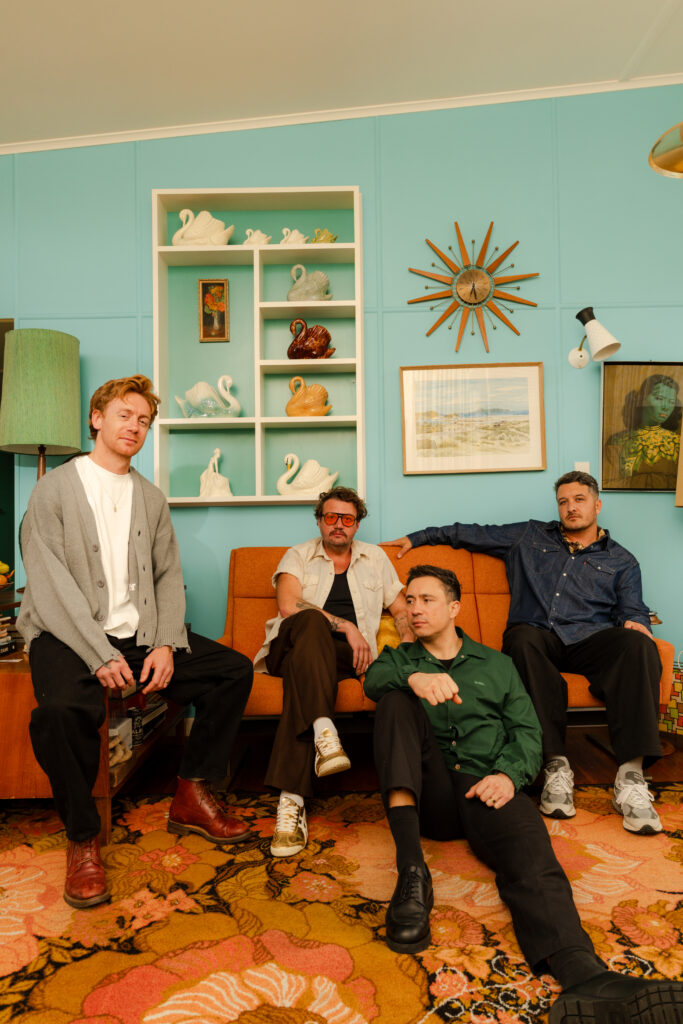
If the Stebbing sessions were the creative pivot, the Grassroots runs were the emotional one. In 2024-25, Six60 deliberately traded stadium spectacle for small rooms and marae, playing more than 50 shows across Aotearoa and Australia. For Fraser, the real challenge wasn’t the recording itself but the months of writing, refining, and figuring out their direction beforehand. That clarity came, in part, from life on the road (April-May 2024), beginning at Pōtahi Marae in Te Kao and travelling through places like Piha, Opononi, Taupō, and Stewart Island. The experience shaped where they wanted to go musically, making the final sessions feel effortless.
He says that shifting from massive stadium shows to intimate gigs completely reset the band’s perspective. Instead of flying into major cities for a few big nights, they were suddenly driving the length of the country, playing tiny venues and remote spots. As he puts it: “The Grassroots tour was like 52 or something… just all over the country… jump in a van… going through that whole process.”
Meeting fans face‑to‑face had a profound effect. Fraser recalls people sharing deeply personal connections to Six60 songs: “(Songs like) Only to Be meant everything to me…” or “I walked down the aisle to Forever…” and “Finest Wine was the soundtrack to my last days of university…” Holy sh*t, man… what a profound impact some of these songs have actually had on people.” Hearing these stories reminded the band of the emotional weight of their early music. He admits they can sometimes forget their importance when they’re “too busy getting out there and getting after it,” but the Grassroots Tour brought them back to centre: “It probably reignited and reminded us of why we are where we are and what we needed to honour.”
One way they did that was to circle back to the Chatham Islands in early December last year, which was meant to be part of the original Grassroots Tour. He describes arriving with no idea what to expect. “I kind of imagined like a wild bush in the middle of the ocean… but it’s massive… an enormous farm with a lagoon the size of Rarotonga.” The band was warmly welcomed. “We really got looked after by everyone… fed seafood – more seafood than we could ever finish.” One particularly special moment was being shown around by a community leader. “I got taken around by the highest‑ranking Moriori on the island… hung out with his family for the day.” The experience was so meaningful that the band now wants to make a tradition out of visiting remote places. “I think we’re going to do that every year… fly somewhere crazy and do a grassroots show.”
He goes on to list some of the most unforgettable remote shows. “Stewart Island… Great Barrier… the Tipuka Tavern in Tokamaru Bay… places more remote than Great Barrier. People just turn up on horseback.” These moments have become some of the band’s most cherished experiences. “They are really special to us now, and I think we’re going to keep doing it.”
This year will be another big one, but they’re not abandoning scale – far from it. This year includes an album‑release show, a Homegrown headliner, and a stadium spectacular with Synthony in Christchurch, complete with orchestral arrangements already underway. The orchestra format, Fraser says, gives the songs fresh weight without sanding off their groove: “Having a string section can add so much emotional weight… it makes it a totally new experience.” The band’s schedule confirms dates in February (Tāmaki Makaurau / Auckland); March (Kirikiriroa / Hamilton), and May at One NZ Stadium, Ōtatahi with Synthony – Once In a lifetime. This will be a large‑scale live music experience that fuses EDM and pop with a full orchestra, alongside DJs, vocalists, and immersive visuals (The show also features Kaylee Bell and Cassie Henderson).
“And that’s going to be an incredible show.” Fraser reckons (they’ve already been down to check out the new stadium). “There’ll be three parts to the show. There’ll be a Symphony part, there’ll be our part, and then there’ll be, there’ll be a part where we perform some of our tracks with the Symphony as a backing track to us. So, we’ve already been putting tracks together with the conductor and there’s a lot of moving parts, but you know, we’re pretty well seasoned on the old stadium stage now.” But orchestras are a completely different beast. “It’s just exciting because of all the possibilities, all the things we’re talking about doing and the sky’s the limit. Usually, just, like, everything’s just sitting in our heads, you know? We’ve obviously done it 9000 times. But, like orchestras that write everything out to the absolute minute detail. It gives you a bit of structure, which is cool, and it creates a whole new experience.”
“We did some work with the Auckland Philharmonia (In 2012, Six60 collaborated with the APO to perform a special orchestral version of their song Lost,)” he continues, “That was maybe six or seven years ago. But just I remember playing that and just being blown away at like the energy and the emotion that the orchestra added. This will be that like times 10, you know, at a stadium!”.
They are also looking forward to performing at Homegrown, which moves from its old home at the waterfront in Pōneke to Claudelands, Kirikiriroa. And it’s with mixed feelings that Fraser acknowledges this. “It was such an iconic show and we kind of cut our teeth at Homegrown in Wellington. Like those are some of the first, those early Homegrowns some of our first really big shows, you know, like when you’re hitting like the 10,000 (people) mark, you’re getting like pretty serious about your live show and all of that.” But he’s also optimistic for the future of the festival, “I mean, it’s cool to headline the new one up in Kirikiriroa / Hamilton!”
Six60 already holds a place in the hearts of many New Zealanders, and their songs are on BBQ and road trip playlists, in wedding and celebration schedules, their gigs are well booked up in family calendars, and their CDs are stuffed in glove boxes, under beds and on the shelves of most home entertainment units. They are iconic already. This new album should cement that even further, I suggest. Everybody has a special place in their heart for Six60 in some form – so keep doing what you’re doing. “Thanks, man. I really appreciate that. We’re looking forward to taking this album out there, making some new memories.”
Right Here Right Now is out on 13 February 2026
13 February 2026 – Te Paepae Theatre, Tāmaki Makaurau (Album Release Concert)
14 March 2026 – Jim Beam Homegrown (Headlines) – Hamilton, NZ (Claudelands Oval)
16 May 2026 – Synthony: Once In A Lifetime (also feat. Kaylee Bell, Cassie Henderson, Castaway)- One New Zealand Stadium, Christchurch
Related Acts:
About the interviewer Tim Gruar

Tim Gruar – writer, music journalist and photographer Champion of music Aotearoa! New bands, great bands, everyone of them! I write, review and interview and love meeting new musicians and re-uniting with older friends. I’ve been at this for over 30 years. So, hopefully I’ve picked up a thing or two along the way. Worked with www.ambientlight.com, 13th Floor.co.nz, NZ Musician, Rip It Up, Groove Guide, Salient, Access Radio, Radio Active, groovefm.co.nz, groovebookreport.blogspot.com, audioculture.co.nz Website: www.freshthinking.net.nz / Insta @CoffeeBar_Kid / Email [email protected]
More by Tim Gruar
Gig Review: Mā @ Tāwhiri Warehouse, Wellington – 28/02/2026
MNZ Interview: Pos Mavaega
Album Review: Did I Hurt Somebody?
MNZ Interview: Lou’ana
MNZ Interview: Julia Deans / Fur Patrol
EP Review: We Built This World With Aroha

MNZ Interview: Moss Te Ururangi Patterson
Album Review: 6IX
MNZ Interview: Rob Ruha