Back in 2016, a weasel (some say it was a beech marten, but nobody can tell for sure) found its way into CERN’s large hadron collider in Switzerland and short circuited the particle accelerator. Some esteemed astrophysicists have proposed a controversial, yet totally believable fringe theory, that the event may have shifted reality into a different timeline since then. While the sentiment may not be shared by many, one hard working surf-tinged rock band from Wellington certainly share the view that the world has been quite strange since the Covid lockdowns. They may not be aware of the ‘Weasel Timeline’ (yes, it’s a thing, go look it up after reading this review) but Wellington rockers Underwire are inspired very much from the disillusionment, confusion, frustration and resulting comedy that defines our age.
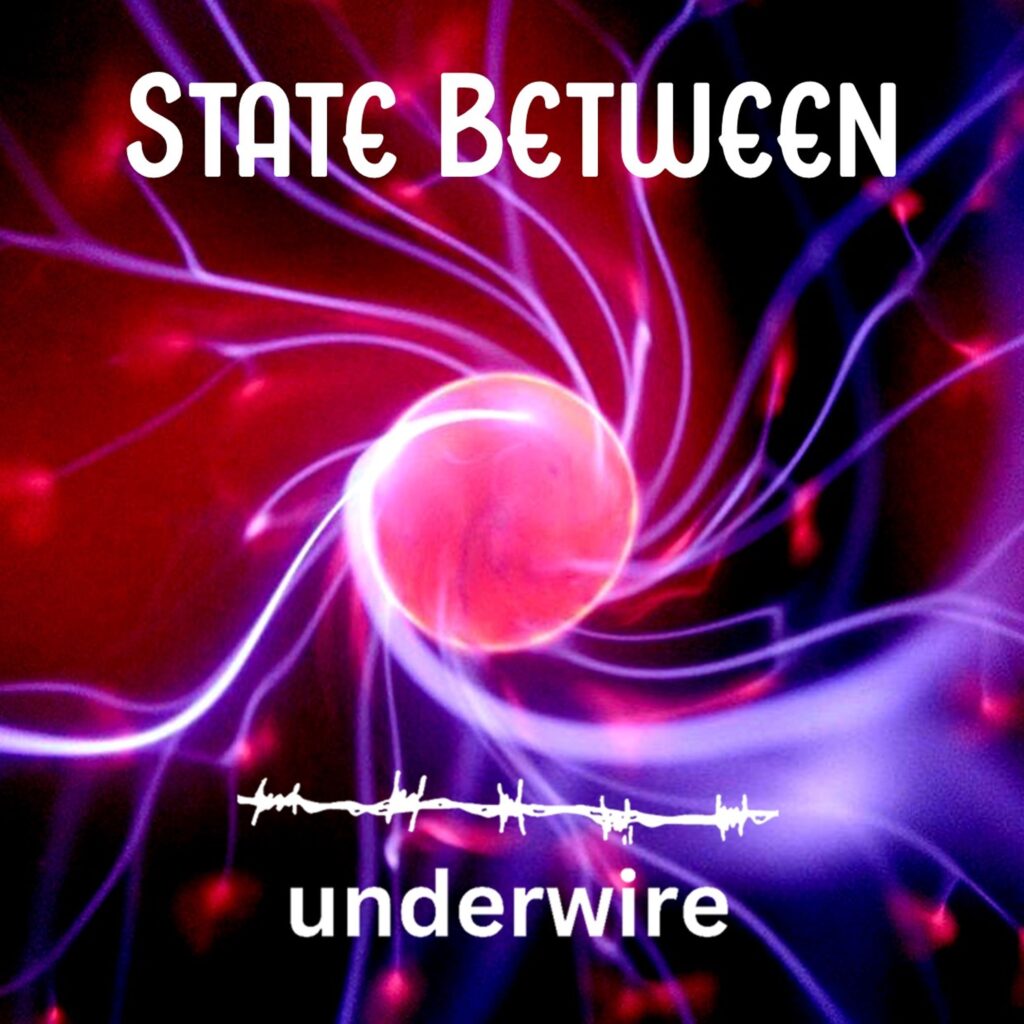
Underwire was crafted from mixing the remains from a Pixies cover band and a Clash covers band along with some musically gifted friends, refining their unique sound in vocalist’s Jane Brimblecombe’s Shelly Bay art studio. From then the band has been steadily growing in popularity while slowly drip feeding some fantastic tunes that now contribute to their long-awaited full-length album, State Between. Like the name hints at, the band is not one solid thing, but fluctuates easily between genre, who the main vocalist is (Jane or guitarist Johnny Mills take the lion’s share, but not always) and mood; sometimes changing within the same song! Likewise, the songs are written by different members or are the resulting fruit of a whole band jamming. They operate making deft use of their ability to blend surf, reggae and rock. Altogether, it’s a heady brew made up of catchy sun kissed ballads with tasty melodies and hard rocking anthemic sing-a-longs that are hard to critique. They’re just so gosh-darned perfect! Nothing feels too long, too complex or too experimental … and before you say, ‘ah ha! A lack of risk-taking is itself something to critique!’ the wide range of styles on offer here keeps things fresh and delightedly unexpected. There’s hints of The Stooges, The Ramones, The Wailers, Beach Boys and of course, The Clash swirling around in here. But there’s also something decidedly kiwi about the whole thing that’s harder to put your finger on. It could be the lyrics that borrow turn of phrases and NZ slang, or the charmingly (deliberate) sloppiness to some riffs are reminiscent of Th’ Dudes, The Clean and Hello Sailor. On a few tracks, there’s ghosts of new wave too (not the cringy bits). What can I say – it’s an orchard.
The recording spans all the way back to 2021, where the band recorded at Massey University with Mike Gibson and Robbie Pattinson with mastering by Scott Seabright. Then, more sessions were recorded in 2023 with Seabright again, with Jackson Kidd as a studio assistant. Finally, more sessions were completed with Seabright alone at the Scott Seabright Production studio in February this year.
Album opener Greener features an infectiously simple punk riff that joins a surf beat and gang vocals. Slide guitar joins the merriment and by the time the chorus hits you can’t help singing along: ‘it’s a lie, it’s a lie! They say its greener on the other side!’. The song itself, like many others on the record, have a message that if it isn’t personal, its political. This one is that later, protesting corporate green-washing and, perhaps, gaslighting the consumer. By contrast, second track Simulation is defined by a bloody genius lead guitar line that gives the same structure to this song the punk riff did to Greener. It’s a pop gem complete with cheeky lyrics: ‘sometimes you talk, like somebody was asking you, sometimes you talk, like you’ve got something to say’. New wave influences are showcased here with keyboards played by Seabright.
Always is a reggae rocker written by lead guitarist Mark ‘Spike’ Roxburgh, but while the easy swagger might make the listener think the song is about blissful ignorance, the lyrics hint at sorrow and regret: ‘as always, there’s a girl, walking from your life, messing up your world, as always…’ but the effect on the listener (like most reggae) is to sing-a-long to the ‘who-ohs’ in sympathy. This contrasts with Gloves Off, which is a ballsy classic rock tune with lyrics of bravely speaking uncomfortable truths: ‘when the gloves come off again, I remember you were not a friend …When I’m struggling for words, And then I know just what to say …well fuck you anyway, ‘cause you’re trouble all the time!’
Right to Crisis features a cool effects laden introduction before the protest anthem kicks in against a world of perceived correctness. The lyrics here are ironic and sardonic: ‘cause freedom don’t come free … you talk of inclusiveness, then slam the door on me.’ There’s an anger here to unfold, but its expressed like a well composed letter to the editor rather than a shouted slogan, and all the better for it.
Other lyrics seem far more personal and hint at real or imaginary disagreements between Mills and Brimblecombe (who are partners) and one of the many examples can be found in Calling Out (actually written by Mark Roxburgh) which tells the story of a relationship on the rocks: “calling out again, she means it, walking out again, you better believe it”. It’s four on the floor fun, with a great chorus (“this time we’re taking it too far!”) but the words are dead serious. This theme continues into Heatstroke, a raw, frantic, bluesy rock song with cleverly interweaving bass and guitar lines. Brimblecombe takes the lead vocal on this track delivering a heartfelt performance that speak of anger and resentment, but ultimately, mutual acceptance: “you’ll never catch it, ‘cause you never try, maybe you lost it, and so have I”.
Title track State Between is a slow burner that features the unique tremolo from Mill’s treasured Holden 50 amp. The song was written based on a mishearing of ‘Nirvana’ as ‘Nevada’, and the concept of the “bardo”: a state between death and reincarnation in Buddhist religion. ‘If you can still hear chanting, keep going’. There’s a little hint of the B52’s on this track which is a nice influence. While this track and others are, if not transcendental, then definitely serious in tone, the band allows some humour in the aptly and hilariously named Bad Evil Surf Music written by bassist Steve Tremewan which features yet more tremolo after a muscular bass introduction. The song is dramatically theatrical, but tongue is firmly held in cheek. ‘I just can’t get enough!’
As the album comes to a close, you’d imagine the energy levels might drop, but if anything they accelerate. Wish I Was A Cowboy is pure country-western fun with inspired percussion at the bridge from drummer Mark Hamill. Gravity is the band’s first single and created quite a stir on shows on US and UK radio play. It’s emotional, sure, but a rocker through and through with a poppy chorus defined by confronting lyrics: ‘cause you don’t really want to change!’ The band plays great on this track, bouncing along with an infectious energy. As with other songs, the lyrics could be construed as combatively truthful, as if they are lines forged during couples therapy: ‘I feel the earth move when you’re walking, I see your lips move when you walk … but I don’t like what I’m hearing anymore’.
Finally, the album ends on my personal favourite, Falling All Over, a fast-paced love song that I first thought was placed inappropriately until I perceived it as the real show finale it is. In fact, this whole album could be played in order in a live setting. There’s screams and yelps aplenty, passionate drumming and raw vigour from the band. There’s a great start-stop rhythm that is hard to ignore and easy to dance to, and the song (and record) ends with a dramatic slap.
Quite frankly, it’s a thrilling ride that seems much shorter than its twelve tracks. There’s no filler whatsoever – each song tells a slightly different perspective on life in a wide range of styles, although every track is undoubtedly Underwire firing on all cylinders. Each instrument, and vocal line, plays an integral part and forms the foundation for the song or the embellishment that swirls, weaves or decorates the former. I suggest seeing these rockers soon at a venue near you to witness some of the finest rock this timeline has to offer.
Related Acts:
About the author Nicholas Clark
Aspiring Writer / Musician / Philosopher / Caffeine enthusiast. I like to create, write about and talk about music. Let’s have a coffee sometime and nerd out.
More by Nicholas Clark
Gig Review: Earth Tongue @ San Fran, Wellington – 21/02/2026

Album Review: Soothsayer
Album Review: For If The Flies
Gig Review: High Dependency Unit @ Meow Nui, Wellington – 26/11/2025
Gig Review: Beastwars @ Meow Nui, Wellington – 22/11/2025

Album Review: Be A Little Kinder
Album Review: There’s A God

Album Review: Believers Punishment (Extended Version)
Album Review: Ill Intent
EP Review: The Fire
EP Review: What A Night

Album Review: Mental Notes Project