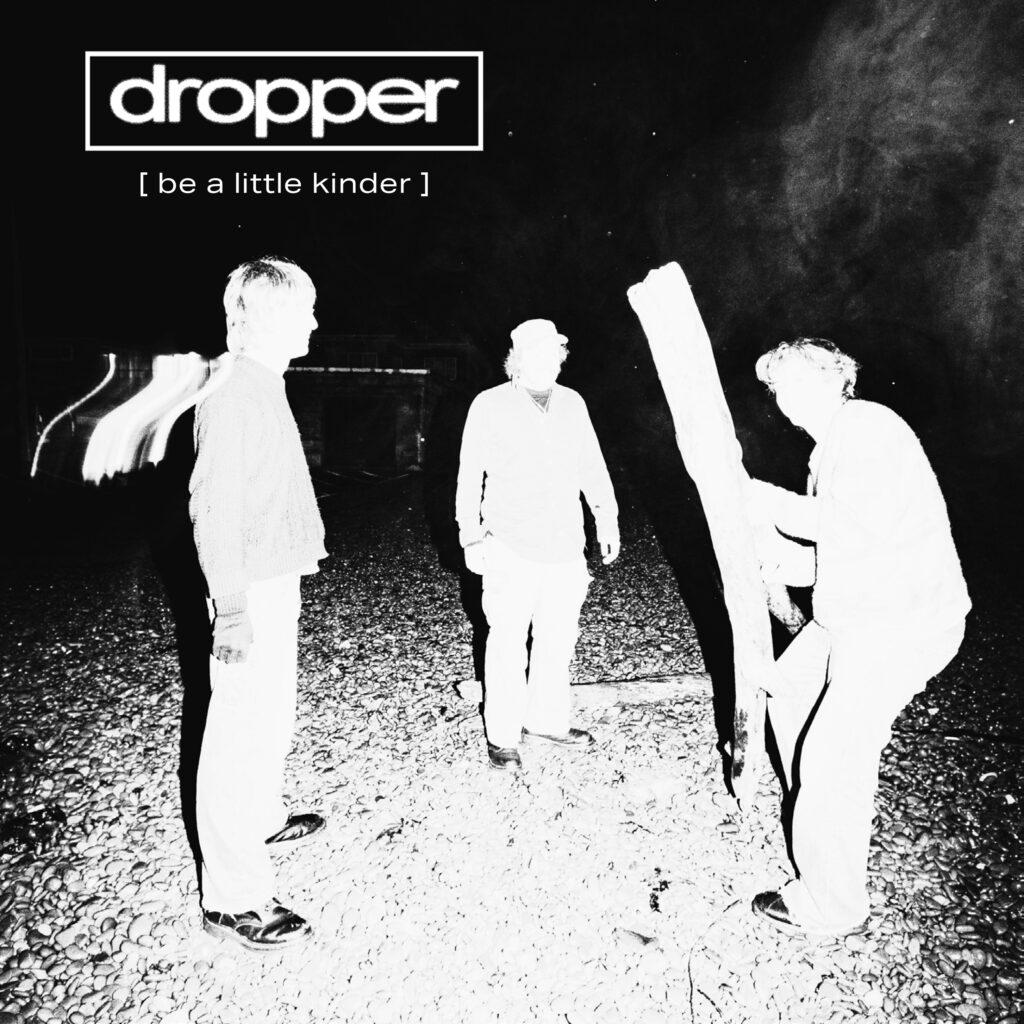
Dropper’s eleven track album, Be A Little Kinder is a lean, pop influenced collection of rock songs with clear nods to Midwest Emo / math-rock, with some kiwi Dunedin jangle-pop and a splash of Britpop. The band is nimble indeed on their debut, displaying intricate guitar parts that fit in well with fast, (but not overwhelming), drum parts. The crisp, nearly punk approach to the production allows Jude Savage’s clear vocals to detect sweet spots in the mix whilst delivering heartfelt lyrics covering topics such as time passing and ultimately, (though hidden in metaphor throughout), mortality.
There’s a wide range of dynamics to be enjoyed, but the most notable examples of switching between intensities are to be found within the songs themselves rather than comparing tracks across the tracklisting. The listener is propelled through swift, elaborate sections filled with blooming, warm overdriven tones often interspersed with squealing feedback – juxtaposed against delicate moments when the band pulls back to one undistorted instrument floating in liberal amounts of reverb. The songs themselves don’t alter much from one to another and a prevalent style becomes apparent half-way through listening to this collection. Complex as the pieces are themselves, the songs utilise a vigorous trick of suddenly shifting from the roar of the full-blown band down to one guitar. But, hey, the technique is useful and from my experience of seeing this band live, I can assure you it really pays off in a gig setting. Other stylistic elements are using what sounds like an open tuning to create lots of moody, suspended chords (particularly making use of what musician’s refer to as the 9th) that sound truly dramatic in some progressions, all nicely set against optimistic, major melodies. Combine all this with the emotionally charged words about loss, regret and guilt – you’ve got a captivating amalgamation that is treated in eleven different permutations, albeit without much general experimentation.
Now, some might argue that by removing or replacing one aspect of a good formula, (all in the name of experimentation), only ever leads to ineffective outcomes – so why upset the trolley when its rolling? Be A Little Kinder contains an element of unpredictability represented by a range of unconventional sounds the guitarists fashion from pedals and amplifiers (including tones that sound either synth-like, a balloon, or even bagpipes) at the beginning and ends of songs. Apart from these odd moments of sound exploration, there is a moderate overdrive applied to most of the guitar parts on the majority of the songs that allow the melody to shine and the bass to bounce. This approach results in eleven songs that could all potentially become (and are worthy of becoming) a pop rock anthem. Also, they could be delivered in any order over the album. This results in the lack of a specific ballad track, the expected ‘epic progressive rock attempt’, the song where the band plays at their heaviest and fastest just-for-the-hell-of-it, the business-focused attempt at a radio friendly punk-pop single, etc. The outcome of this method? A solid cast of outstanding full-blown rock songs, one after the other.
Many, especially those in the Wellington music scene, will know Dropper takes its name from Bleeding Star’s third and final album; a band that singer/guitarist Jude Savage and guitarist Carlos Bellamy were once in together. After the passing of Bleeding Star’s guitarist Otis Hill, the band played only six more shows with River Hann-Ellen from Debt Club taking guitar duties, then dissolved. In the summer of ‘24, Savage and Hann-Ellen began writing on what would become Be A Little Kinder. Now, with Walter Martin on drums and Toby Gracewood-Easther on bass, Dropper have launched with a solid set of tunes that showcases their talents and passions.
Anchor begins with a chime-like guitar part that’s joined by a bold bass line that puts the original part on the upbeat. It creates a surprise, as if things are not always what they seem, then into a pleasant, if sentimental, mood of uncertainty that is to prevail throughout the record. Savage’s voice here is clear and bell-like too, issuing admissive lines such as “blinded by my anger,” which begin the track. The lyrics are vulnerable, confessing that “no apologies seem fitting, always had me second guessing”. There’s immense hurt that seems brewing beneath the delivery, matched by the intense feedback that drenches the whole mix at moments while the instruments hold their breath. The song crawls at the end, suddenly pulling back to a single guitar to deliver an emotional phrase before entering a half-time heavy riff. The song has an impressive arrangement, and is perhaps subconsciously an ode to Smashing Pumpkins outstanding song Mayonnaise.
Through Your Teeth is an even more apparent example of enthusiasm for math-rock of the Midwest variety. It too features breaks where the band squeezes down to a single guitar line in mere seconds for dramatic effect. The song has frantic drum parts that somehow sound tidy and move well with the punctuated bass. The lyrics are a little soppy, but they cut through the sound: “I hope he treats you better … did he read your letter?” It’s a bit of a shame the background vocals sound so thin in comparison to the double-tracked main vocals. The tune ends with a sound like a balloon being strangled.
Pinwheel has some great Johnny Marr-esque arpeggios, and features the smooth glittery voice of Eveline Breaker, although her lyrics are quite hard to hear. The song is likewise emotional, featuring a great chord progression that sounds a little influenced by 90’s skater pop-punk. The lyrics here are personal and directed to somebody specific: “you kicked the door through, I kept my promise to help you, pictures on the white walls don’t help, wishing I could take them down myself”. It was now, during my first listening to the album, that I realised how much the band sounded like Hüsker Dü, Dinosaur Junior and Pavement, not necessarily through guitar tone or singing style, but approach to song structure and general production.
Is the Worrying Working? has some distortion that gets a little hissy by the end of the song and makes it hard to hear the vocals at times. The guitars also create an interesting bagpipe effect which is interesting and strangely stirring. Savage warns the listener he’s “running out of time, as moments pass by” while his object of desire or frustration is “getting further every day, drifting into space, the expression on your face”. It’s a good example of what the band can achieve but not the first song I’d show to a new listener.
You Do You, in comparison, is a shining example of what Dropper can be at their best. The song is really catchy and is set at an alluring tempo. The vocals sound hopeful – “cry to me if you desire, think about what you admire”. There’s a great little guitar solo complete with sincere bends and the song does sound quite Brit-pop to me. “You, you do you,” sings Savage unaccusingly, “chase away the way you were back then, fall upon your ignorance again”. The vibe of the song seems to be about letting go and allowing others to follow their own paths, even if we feel they might be unwise.
Whatever Works For You begins with a little bit lower energy than the rest of the tracks, but after some clever sophisticated guitar moments the band returns with some fresh vivacity. The song has some quick breaks for the band to fill in with either a snappy drum fill or a moment of feedback. This song has a similar attitude to the last track; feelings of detachment are expressed but there’s a sense of care for whoever is listening: “I watched you drive away, your eyes so cold and grey, if you need me I’ll meet you halfway”.
Your Face Says It All is the single of the album, but I’m a little surprised by this choice. The song features a nice acoustic guitar introduction, joined later by warm overdriven guitars. The bass is a little less prominent on this track, but this only allows the voice to shine more clearly throughout. There’s a great call and response between guitars that forms the foundation of the song. A rather joyful sounding guitar solo would have you thinking the song was jubilant but the lyrics divulge a type of betrayal: “there’s nothing left to do, I don’t want to be around you, I never wanna speak to you, I only want a piece of you, I’m never running back to you…”
Didn’t Want To Be Your Light is perhaps the heaviest the band gets, or at least, it has the most drastic dynamic changes. The band plays deftly and fervently on this track, blooming into a full-scale rocker, ending abruptly and unexpectedly at the conclusion. The lyrics here are more caring and less accusatory: “it’s alright for you to cry, still haven’t made up my mind, didn’t want to waste your time, but my watch keeps ticking by, it’s alright if we collide, still haven’t decided why, didn’t want to be a lie, we were young, we had it right”.
Bleed Out features an unusual synth-sounding guitar part as an intro, transforming into quite a punky number. However, it’s hard to decipher the lightly shouted lyrics under the shimmering guitars at full force.
Breathe Through The Wire has a protuberant bass sound amongst reverb-drenched chiming guitars. Then, the band brings in a crushingly heavy detuned guitar part, but the sense of the track is sadness being expressed as opposed to anger. The lyrics match this depressed state: “I’m here to waste your time and you’re so full of bright ideas, can’t help but share your sickness”.
Be A Little Kinder is a short, sweet and fast-paced album closer. It’s surprising that the song is a speedy rocker after so many medium paced ones, but it’s a nice way to end the collection with a bang. The guitars create one of the most outlandish sounds on the record on this track, ringing out like a blaring detuned radio a la Sonic Youth or Tom Morello. “I can’t change you; you change anyway!” Savage shouts. True enough. Time marches on. The bell tolls for thee.
What to make of it all? It’s not bad at all. The songs are all well-intentioned and worthy of any listener’s attention. I could see any track transitioning successfully to the live setting. The sounds, apart from the truly wacky beginnings and ends, are fuzzy warm overdrives set against glassy bass with thick rounded drums contrasting with a tight snare. There’s a great play of reverb vs close dry effects and of course, dynamics are put to fantastic use on this album. The titles themselves point to therapeutic processes, or are direct instructions to people in Savage’s life (You Do You, Whatever Works For You, Be A Little Kinder, Is the Worrying Working?) that likewise deal with some kind of loss or a frustrating breakdown in communication. There are recurring themes of time being misused, big decisions, helping others, kindness during loss and redemption.
Overall this is a great debut from a very promising band who have found and enhanced what works for their sound. Snappy, punctual rock represented well on eleven top notch tracks.
About the author Nicholas Clark
Aspiring Writer / Musician / Philosopher / Caffeine enthusiast. I like to create, write about and talk about music. Let’s have a coffee sometime and nerd out.
More by Nicholas Clark
Gig Review: Earth Tongue @ San Fran, Wellington – 21/02/2026

Album Review: Soothsayer

Album Review: For If The Flies
Gig Review: High Dependency Unit @ Meow Nui, Wellington – 26/11/2025
Gig Review: Beastwars @ Meow Nui, Wellington – 22/11/2025

Album Review: There’s A God

Album Review: Believers Punishment (Extended Version)
Album Review: Ill Intent
EP Review: The Fire

EP Review: What A Night

Album Review: Mental Notes Project
Album Review: State Between